Tag: Reasons to call the vet

  • My Horse has Strangles

    My Horse has Strangles

    My horse has strangles, what should I do?  Today I’m going to help you learn what to do to help your horse and to prevent the spread of this disease to other horses.

    I want to thank an anonymous person for helping me write this article.  This person has just had a strangles outbreak at their barn.  They supplied the photos and gave me information on what the farm did to help prevent the spread of this disease.

    What is Strangles?

    Strangles is a highly infectious and contagious disease of the lymph nodes along with an upper respiratory infection.  It is caused by a bacterium called Streptococcus equi subspecies equi (S. equi) and affects horses, donkeys, and mules. This highly contagious disease can be a real nightmare to a farm of susceptible horses.  Strangles is also called equine distemper; the infection typically begins 10 to 12 days after exposure. Yes, strangles has a terrible name and a worse reputation.

    Strangles is more common in young horses but can affect a horse of any age. Strangles is an infectious disease that is contracted from horse to horse through direct contacts, such as touching muzzles, environmental contamination, and shared equipment, such as feed buckets and bridles. This disease spreads rapidly, producing large outbreaks in herds not previously exposed or vaccinated. The infection is especially aggressive in populations of foals and young horses.

    Diagnosis

    Aside from observing the visible physical signs in diagnosis, a veterinarian will be able to confirm a strangles diagnosis by taking a swab from the back of the nasal cavity.

    Symptoms

    The horse experiences a high fever, appetite loss, depression, and enlargement of the lymph nodes between the jawbones. Many have thick, yellow pus draining from the nostrils. The disease’s descriptive name comes from the “strangling” noise produced as severely affected horses struggle to draw breaths into their obstructed airways.  Sometimes horses do die from the struggle to breathe.

    Signs can last for a few weeks to a few months. Abscesses usually rupture and drain within two or three weeks. When abscesses burst, thick yellow pus is discharged, and recovery is generally without incident.  Abscesses in the lymph nodes of the head and neck can cause coughing fits and difficulty swallowing.

    Treatment

    Immediate veterinary advice should be sought to alleviate the symptoms in individual horses, and to prevent its spread to other horses. Each case should be assessed and treated individually by a veterinarian, as clinical signs and the severity of the disease can vary between horses.

    Treatment for strangles varies case by case. Treatment typically includes penicillin, anti-inflammatory drugs, such as phenylbutazone and flunixin meglumine (Banamine), which are indicated to reduce fever and swelling.

    Affected horses should be isolated for six to eight weeks to prevent spread to other horses. Good biosecurity must also be observed when handling infected horses.

    Complications

    While most horses recover with supportive treatment, complications may occur in up to 20% of affected horses.  Complications are primarily from secondary pneumonia that takes hold in debilitated or immune-compromised animals. Abscesses may also form in other areas of the body, such as the abdomen, lungs, and brain. This is considered a chronic form of strangles called “bastard strangles,” which can have serious implications if the abscesses rupture. Horses develop this form of strangles when their immune systems are compromised or if the bacteria rapidly invade the body.  As these internal abscesses progress, they can’t be drained or adequately treated, and their rupture within the body cavity usually results in the horse’s death.

    Safety Protocols

    When you have a horse or several horses on a farm that have strangles but others that do not show signs, it is best to take extra care not to get the non-exposed horses exposed.

    Example 1: Star is away at a show and comes back to the farm and soon shows signs of strangles.  Star is put into a quarantine barn away from the other horses.  Star is cared for by a single person, and all other barn personnel is not allowed to go near the confined area.  The caregiver removes her shoes and put on rubber boots before entering the quarantined area to care for Star.  When she leaves, she then puts on her shoes.  This prevents her from tracking the bacteria to other parts of the farm.  Before the caregiver goes to see any other horses on the farm, she disinfects herself and showers, and changes clothing.

    When Star gets an abscess that bursts and making her exceptionally infectious, the stable dedicates one person to take care of Star and no other horses.  This prevents the bacteria from going to any other part of the farm.

    Example 2: Example two is about a farm of 42 horses and how they handled a case of thirty-four horses coming down with strangles. Since it is quite long and detailed I’ve created a second article just for that experience. This farm has been generous enough to provide the photos for the two articles.   Thank you very much.

    Most horses continue to shed S equi particles up to a month after recovery. Three negative swabs, at intervals of 4–7 days, should be obtained before releasing your horse from quarantine.  If you choose not to do swabs, the minimum time of isolation should be between one month to six weeks.

    Vaccination against strangles provides excellent protection to horses. However, treatment alone should not be considered an absolute preventative due to differences between individual horses, the time since vaccination, and the level of challenge to immunity. Speak to your vet about the protocol.

    Conclusion

    In addition to vaccination, all newly introduced horses should be monitored closely for three weeks after arrival, and ideally quarantined from other horses during that period. Any horse that develops signs consistent with strangles should be isolated immediately and examined by a veterinarian to exclude the possibility of strangles.


    Follow DD Mini Farm on Facebook or YouTube.

  • Why should you do a Pre Purchase Exam

    Why should you do a Pre Purchase Exam

    Why should you do a Pre Purchase Exam?  Because you should make sure the horse you want to purchase can do the job you want it to do.

    When purchasing a horse, there are several things to look at, price, location, bloodlines, disposition, conformation, and of course, lameness.  Here are some suggestions of things to look for during your search.  Because every horse purchase and every visit to the same horse is a unique situation, use these ideas and suggestions as a guideline.   No rules are set in stone.

    Before you search for your next partner, you should figure out what you need a horse to do.  Will it be roping, sorting, hunter/jumper, pleasure riding, trail riding, competition trail, etc.?  What type of horse knowledge do you have?  What kind of training will your new horse need to have?  Will you do the training or have a trainer train it?

    Start the Search

    Now that you have narrowed down your type of horse, your price range, the location you are looking in, bloodlines, and how well trained your horse needs to be, start looking for your next horse.  There are several sites on the internet with horses for sale.  Start looking through different websites, talking to people, and looking at horses that meet your needs.

    Once you find the horse that meets your needs, set up an appointment to see the horse.

    A pre-purchase exam is still a brilliant idea even if you trust the person selling you a horse.  Sometimes the person selling the horse does not know the horse and may have an issue.  Sometimes the sellers know about the injury but don’t think it will affect the “job” you want the horse to do.  You can always ask the seller why they are selling the horse.

    Pre Purchase Exams are not just for lameness; a vet will check the horse’s overall health along with its teeth and other vitals.  The vet will let you know if this horse can do the job that you want it to do.

    Meet the horse

    Many people will tell you it is best to see the horse in person before purchasing.   In specific instances, primarily due to distance, people will buy a horse from someone far away and be happy.  Others will buy a horse, have it shipped to them, and find out that they can’t get along with the horse’s personality.  Some realize the horse has not had the training the way it was claimed to be.  Or even to find out that the horse is lame.

    Go and visit the horse; watch the owner or trainer ride the horse first to see how the horse reacts with people and riders that the horse typically works with.  If you have a trainer or an experienced horse person, let them ride the horse before you.  Of course, you must ride the horse before deciding if this could be your next horse.

    If you think that this is your next horse, try to spend some time with the horse and watch it interact with people and other horses.  Find out if this horse has ground manners and how it gets along with other horses.  And how it will do in the type of stabling, you will have for your horse.  A person willing to sell their horse to a perfect new home will not mind you spending time with the horse.

    Will your new horse be out at pasture with other horses or in a stall and turned out in individual paddocks?  How does this horse-like being stalled if it is required to be in a stall?  Does this horse crib?  Does this horse weave?

    Pre Purchase Exam

    If your horse is ridden extensively for show or pleasure, it is best to have a pre- Purchase Exam.  The Pre Purchase Exam will determine if the horse can do the job you have intended for it to do.  The veterinarian is there for the buyer, not the seller.  It is best to make sure that the horse will be the horse you need it to be.  Many people don’t consider a Pre Purchase Exam on horses in the lower dollar value.  Here are two short stories about why even smaller dollar amounts of horses should have a Pre Purchase Exam.

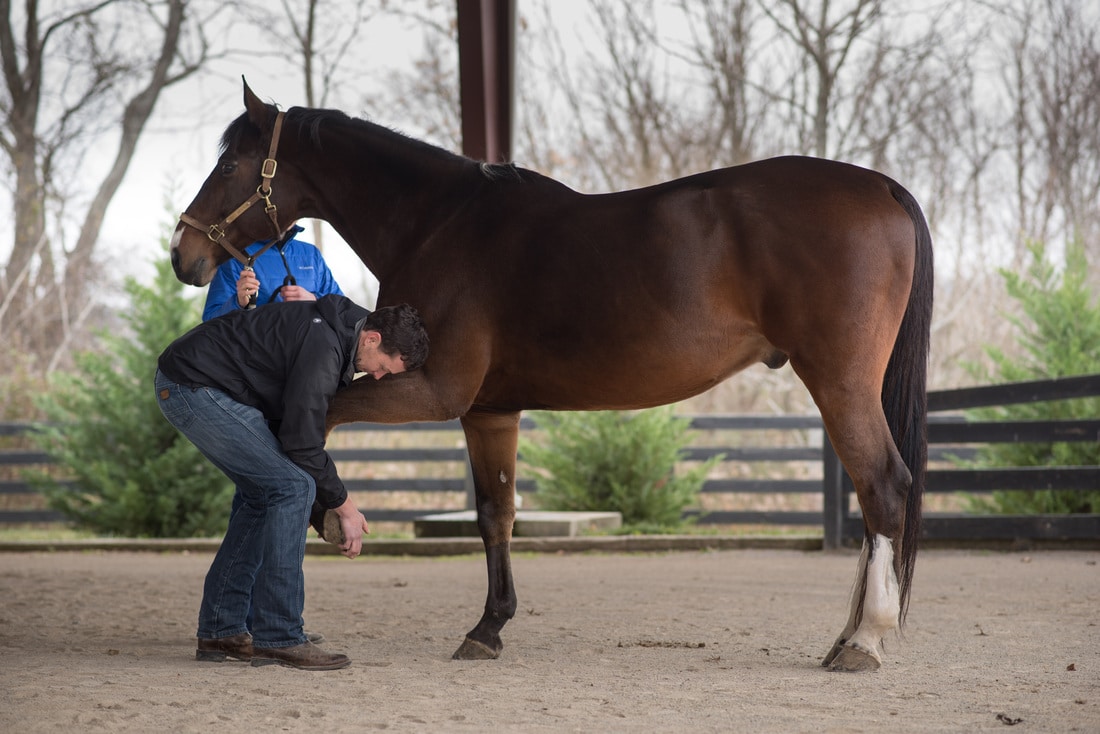
    Photo Credit: Tennessee Equine Hospital
    Example 1

    When my parents purchased my first horse for me when I was twelve, we went and looked at several horses.  I rode many of them and fell in LOVE with a Palomino mare.  My parents purchased this horse for me.  Within a week of her arriving at our place, she was dead lame.

    After our vet looked at her, she had bowed tendons and her stifles locked.  She was on stall rest, and we tried several different treatments.  As it turned out, she could only have some light riding done after a YEAR off.  She was never able to compete like we intended her to do when we purchased her.  This experience is not what a twelve-year-old wanted for her first horse.  One that she couldn’t ride.  If my parents had done a Pre Purchase Exam, we would have known that she had been on a pain block of some sort.

    I read the second example on a Facebook group.  So I contacted the person to ask permission to use her words for this post.  I feel that this is another example of what could go wrong, and she has agreed to let me use her experience.

    Example 2

    My husband and I purchased a gelding last weekend after riding him in the round pen at the farm and discussing our plans with the horse to include a backup sorting horse for myself as well as a horse for my husband to sort on/trail ride with.

    We paid $1,200 and brought him home last Sunday.  He ran around in the paddock with the other horses that night and then showed lameness.  We separated the horse and called the vet out the next day.  She confirmed an old deep digital flexor tendon injury and advised that he not be ridden other than at the walk on trails and an occasional trot.  I was able to contact a previous owner (not the person we bought him from) as well as another additional owner, and both knew of the old injury causing soundness issues.

    We then took the horse to a second vet that specializes in sports medicine to get more imaging done as well as look into possible options for having this horse sound for showing.  The vet advised again that he should be a trail walk/occasional trot due to the old injury.  He did not feel the horse would be suitable for sorting.

    Yes, the horse didn’t show lameness until he ran in the paddock, but both vets indicate the lameness is because the horse has an old injury and not something that happened in our care.

    We have not previously considered pre-purchase vet checks on $1,200 horses, but I will guarantee this will be done before future horse purchases.

    The horse is fantastic, and it is incredibly disappointing that he will not be suitable for us.  It is even more depressing that we were not told about the injury during the purchase.

    Conclusion

    Don’t be in a rush to buy a horse.  Make sure it can do the job that you want it to do.  Don’t buy a horse for color only.  Get the opinion of a vet or farrier before you make that purchase.  If you feel the horse is for you, consider getting a Pre Purchase Exam with your vet.  The vet will check for lameness in addition to the overall health of the horse.

    If you have a story that you would like to add to this post, please send it in for consideration.

    Follow on Facebook or YouTube.